
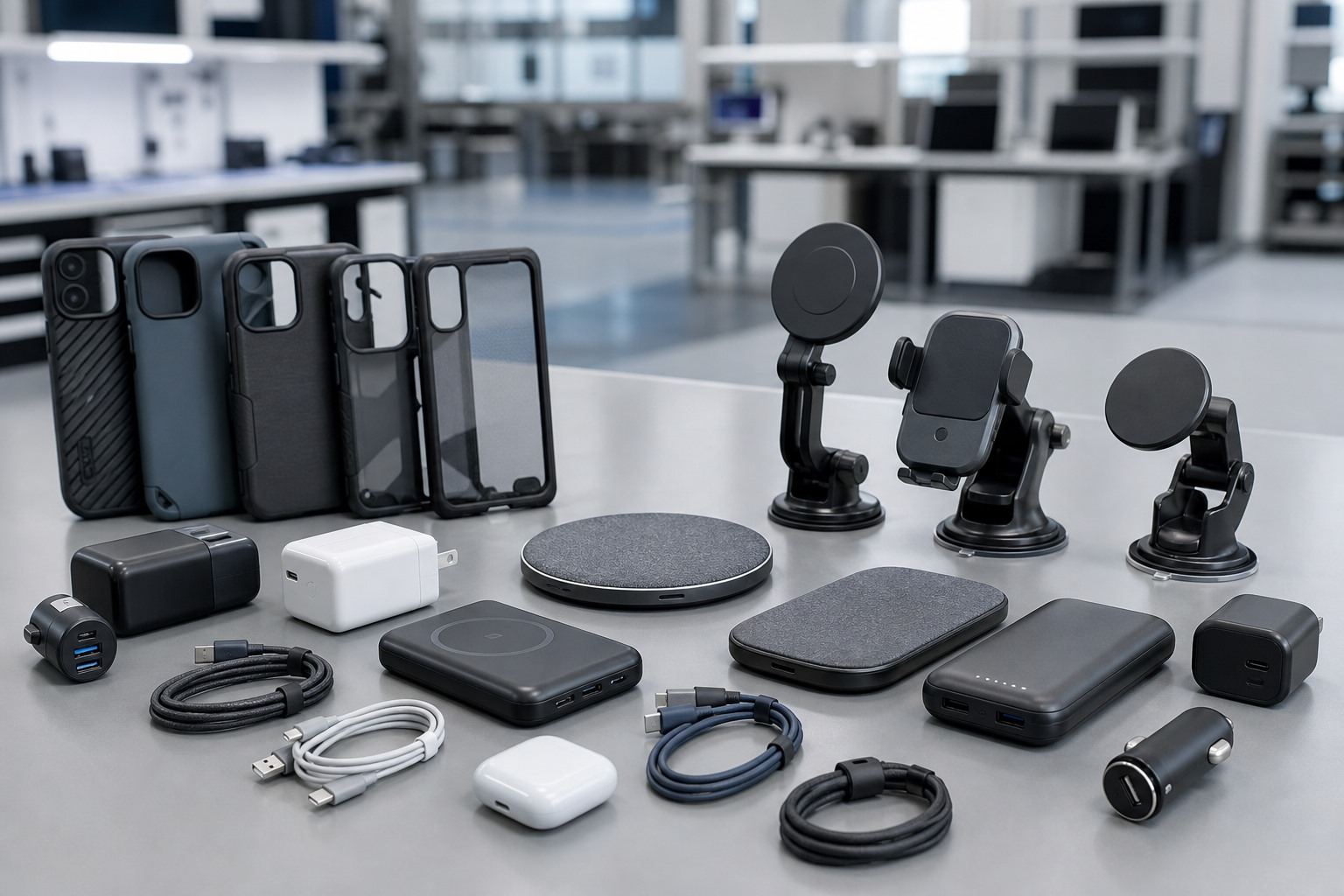
Huaqiangbei is one of Shenzhen's best-known electronics trading districts. For an international buyer, its value is not simply the number of products on display. The district offers fast access to components, ready-made electronics, phone accessories, repair parts, packaging options, and businesses connected to the wider Pearl River Delta supply chain.
That convenience can make product discovery and sample collection remarkably efficient. It can also create confusion. A counter displaying a product may be a factory showroom, a distributor, a wholesaler, a component trader, or an intermediary sourcing from several manufacturers. A successful visit therefore requires a clear brief and a method for checking what is actually behind each quotation.
What Huaqiangbei offers buyers
Huaqiangbei is better understood as a dense electronics business ecosystem than as one single market. Different buildings and floors specialize in different product groups. Buyers commonly visit the district to explore electronic components, phone accessories, cables, charging products, computer peripherals, LED products, cameras, security equipment, audio products, tools, replacement parts, and small consumer electronics.
The market is particularly useful during the early stages of sourcing. A buyer can compare physical products, collect several samples, observe current features and packaging, and speak with multiple sellers in a short period. This is often faster than exchanging incomplete specifications through online marketplaces.
When sourcing in Huaqiangbei makes sense
The market can be a practical choice when you need to:
- Research an electronics category before writing a detailed RFQ
- Purchase samples or small quantities of in-stock products
- Compare components, materials, functions, and packaging in person
- Find replacement parts or accessories for existing product lines
- Combine several related SKUs for market testing
- Identify potential suppliers for a later OEM project
It may be less suitable when the project requires a highly controlled production process, specialized certification, proprietary engineering, long-term component traceability, or large-scale manufacturing without further factory verification. In those cases, Huaqiangbei can still support product research, but the final order should be connected to a qualified manufacturer and a documented quality plan.
Market seller, distributor, or factory?
One of the most important sourcing questions is not simply, "What is your price?" It is, "What role does this business play in the supply chain?" A distributor may offer fast delivery and flexible quantities. A trading company may consolidate several categories and communicate well with export buyers. A factory may provide stronger production control for a focused product type. None of these models is automatically better; the right choice depends on the order.
Ask each supplier where the product is manufactured, which processes are completed in-house, whether the quoted model is normally stocked, who owns any tooling, and who will be responsible for quality issues. Request the company's registered name and business license before paying for a significant order. For a long-term OEM program, arrange a factory audit or video verification rather than relying only on the market counter.
Prepare a focused electronics RFQ
General requests such as "best quality charger" or "cheap phone accessories" lead to quotations that cannot be compared fairly. Before requesting prices, define the product category, intended use, destination market, order quantity, target retail channel, required functions, packaging, and acceptable quality level.
For an electronic product, the RFQ may need to include dimensions, materials, connector type, input and output ratings, chipset or key components, battery details, supported protocols, plug type, cable length, color, logo method, test requirements, and applicable compliance standards. For non-powered accessories, focus on compatibility, tolerances, surface finish, durability, printing, packaging, and barcode requirements.
Use samples as a controlled comparison
Do not collect random samples without recording their source. Give every supplier and sample a reference number. Photograph the product, quotation, business card, packaging, and market location together. This simple record prevents confusion after a busy day of meetings.
Evaluate samples against the same checklist. Depending on the product, this can include appearance, dimensions, fit, weight, materials, assembly, user interface, connection stability, charging speed, heat, sound quality, battery runtime, cable strength, accessories, instructions, and packaging. Testing should reflect how the customer will actually use the product, not just whether it powers on.
Once a sample is approved, create a written specification and retain a signed or clearly identified reference sample. The mass-production order should refer to that approved version.
Compare total cost, not only counter price
Huaqiangbei makes price comparison easy, but the lowest displayed price may not represent the lowest landed cost. Confirm whether the quotation includes tax, export packaging, labels, accessories, customization, testing, local delivery, and any mold or setup charges. Also confirm whether the price applies to available stock or to a future production batch.
For mixed-SKU purchasing, calculate consolidation, repacking, inspection, warehouse handling, export documentation, and international freight. A slightly higher unit price from a stable supplier can be less expensive than managing inconsistent products from several unknown sources.
Control quality before shipment
Electronics quality cannot be judged by appearance alone. The inspection plan should reflect product risk and the approved specification. Basic checks often include model, quantity, workmanship, dimensions, functions, accessories, labeling, barcode accuracy, retail packaging, carton marks, and shipment quantities.
Additional testing may be needed for power, charging protocols, current, voltage, heat, battery performance, connectivity, aging, drop resistance, cable flexing, or other product-specific functions. Some tests can be completed during factory production or pre-shipment inspection; others require an accredited laboratory.
Agree in advance on the sampling method, defect categories, acceptance limits, test equipment, and response if the goods fail. Inspection performed only after all cartons are sealed can be too late to correct serious production problems efficiently.
Treat compliance as a product requirement
Import requirements depend on the product and destination. Electrical safety, electromagnetic compatibility, radio functions, batteries, restricted substances, energy efficiency, product labeling, recycling obligations, and transport rules may apply. Buyers should identify the requirements with qualified compliance professionals before confirming the order.
Do not accept a test report based only on the supplier's name or a similar-looking product. Confirm that the report covers the exact model, ratings, components, plug, wireless function, battery, and construction you intend to purchase. OEM changes can affect whether existing documentation remains relevant.
Intellectual-property risk also deserves attention. Avoid products using copied logos, protected characters, imitation packaging, or designs that may violate third-party rights. A product being openly displayed in a market does not mean it is legal to import or sell in your country.
Payment and supplier records
For samples and small local purchases, payment arrangements may be simple. For commercial orders, use a contract or purchase order that identifies the registered supplier, product specification, quantity, price, quality requirements, delivery terms, payment schedule, and responsibility for nonconforming goods.
Check that the payment recipient is consistent with the contracting business and investigate unexplained requests to pay an unrelated personal or third-party account. Keep quotations, approvals, invoices, inspection results, and payment records together for each supplier.
A practical visit checklist
Prepare before arriving so the visit produces comparable information rather than a collection of unrelated products.
- Bring a concise RFQ, reference photos, specifications, and target quantity
- Create a supplier and sample numbering system
- Carry measuring tools and any compatible devices needed for basic tests
- Record prices, MOQ, lead time, stock status, customization, and payment terms
- Ask for the registered company name and factory information
- Do not approve mass production from verbal promises alone
- Review compliance requirements before selecting the final product
- Plan sample testing, factory verification, inspection, and export logistics
How REGAL Sourcing supports electronics buyers
REGAL Sourcing helps international buyers turn market research into a controlled purchasing project. Support can include product and supplier research, quotation comparison, sample collection, factory matching, supplier verification, specification confirmation, OEM packaging, production follow-up, quality inspection, consolidation, and export coordination.
Our role is not to recommend a product simply because it is available. We help buyers compare the supplier model, product requirements, quality risks, destination-market needs, and total purchasing process before committing to an order. Learn more about our China sourcing services and phone accessories manufacturing guide.
Frequently asked questions
Is Huaqiangbei suitable for small orders?
Many sellers can provide samples and small quantities of in-stock products. MOQ usually increases when you request custom colors, logos, packaging, components, firmware, or a new production batch.
Are Huaqiangbei sellers factories?
Some businesses are connected to manufacturers, but many are distributors, wholesalers, component traders, or sourcing intermediaries. Verify the legal company and production source according to the size and risk of your order.
Can buyers develop OEM electronics there?
Yes, Huaqiangbei can help with product discovery and supply-chain connections. A serious OEM project still requires a detailed specification, sample approval, manufacturer verification, compliance review, production control, and inspection.
What should be inspected before shipment?
Check the approved model, quantities, appearance, functions, accessories, labels, packaging, barcodes, cartons, and product-specific performance. The inspection checklist should be agreed before production.