
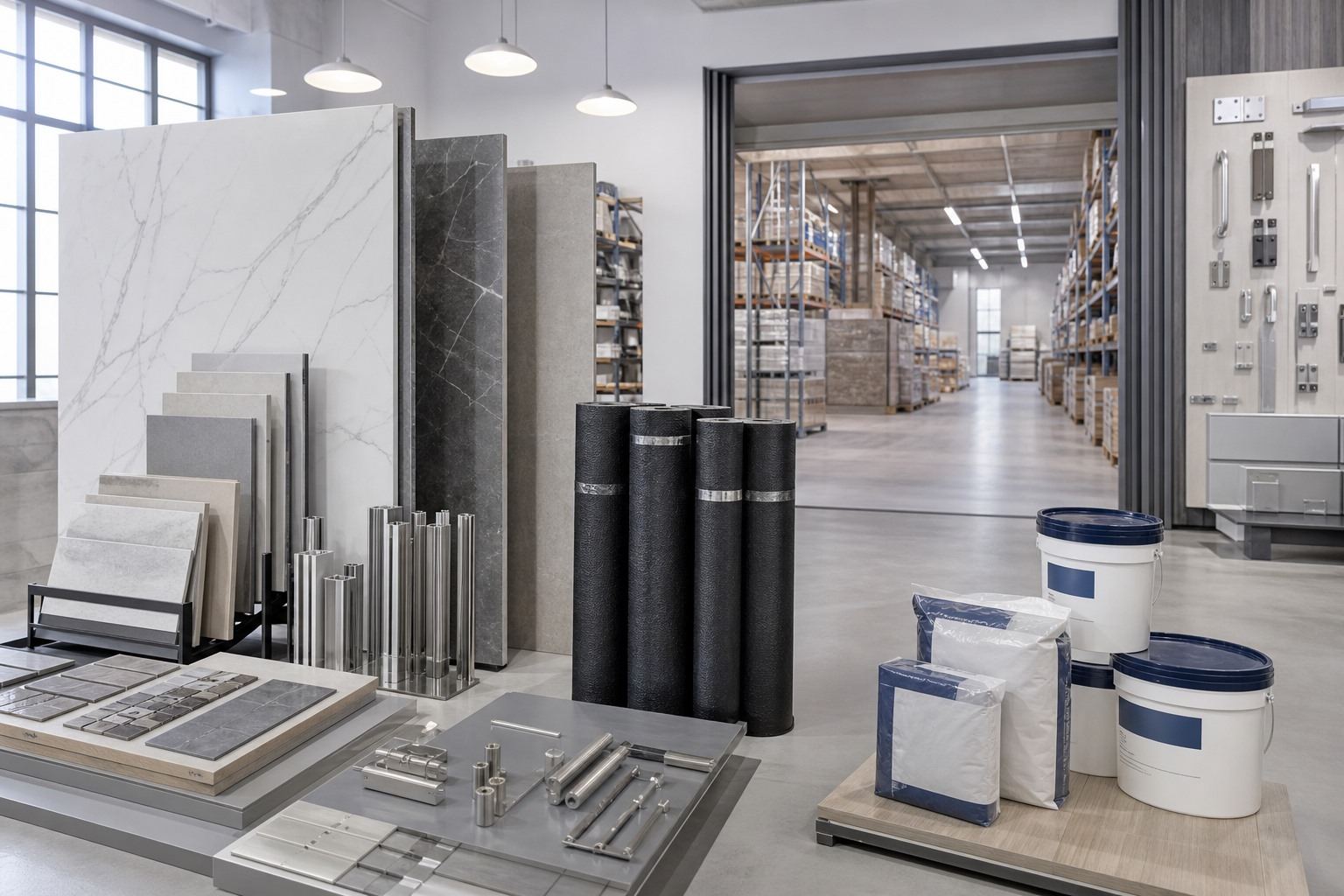
Building materials sourcing combines technical procurement with project logistics. Products must match drawings, dimensions, finishes, installation systems, local requirements, and construction schedules. A sample may look correct while the full shipment has color variation, dimensional problems, missing accessories, weak packaging, or inconsistent batches.
Buyer priorities
Importers and distributors need repeatable specifications, commercial packaging, stock or reorder planning, and competitive landed cost. Contractors need approved submittals, complete installation sets, delivery sequencing, and rapid technical clarification. Developers and hotel groups care about visual consistency, maintenance, spare parts, and lifecycle performance. The sourcing plan should reflect who approves the product and who carries installation and compliance responsibility.
Major building material categories
Tiles, stone, and decorative surfaces
Ceramic and porcelain tiles, mosaics, engineered stone, natural stone products, wall panels, and decorative sheets require control of dimensions, thickness, calibration, shade, pattern, surface finish, edge quality, water absorption or performance properties, breakage, and packing. Natural materials need an agreed range because every piece cannot be visually identical.
Flooring, wall, and ceiling systems
Vinyl, laminate, engineered wood, rubber flooring, acoustic panels, ceiling materials, cladding, and partition products differ in construction, wear layer, density, finish, locking system, substrate, installation, emissions, fire performance, moisture behavior, and maintenance. Confirm the complete system, including underlay, trims, adhesives, profiles, and spare quantities.
Doors, windows, glass, and profiles
Project doors, aluminum windows, profiles, glass products, and related hardware must follow openings, elevations, schedules, wind or environmental requirements, glazing, finish, drainage, seals, locks, and installation details. Final production should use approved shop drawings and a controlled hardware schedule.
Architectural hardware and metal products
Hinges, locks, handles, brackets, rails, fasteners, channels, stainless products, and fabricated metal parts depend on material grade, thickness, machining, welding, plating, coating, corrosion resistance, tolerances, load, and compatible fasteners. A decorative sample does not prove long-term mechanical performance.
Waterproofing, sealants, adhesives, and insulation
Chemical and performance materials need especially careful product selection, shelf-life control, batch traceability, storage, transport, application instructions, substrate compatibility, climatic suitability, and destination compliance. Claims should be supported by relevant technical data and testing for the exact product.
Find the right building materials supplier
A showroom company may offer strong product coordination but outsource manufacturing. A specialist factory may control one process well but cannot supply a complete project range. A project supplier may combine several factories and provide consolidated submittals, samples, and shipments. Buyers should choose based on project complexity rather than assuming one model is always superior.
Verify the legal entity, factory location, product specialization, raw-material control, equipment, laboratories or test methods, capacity, subcontracting, quality records, export markets, and similar projects. For custom products, review engineering and drawing capability as closely as production equipment.
Create a comparable RFQ
Provide drawings, schedules, quantities, dimensions, materials, grades, finishes, colors, performance requirements, installation conditions, accessories, packaging, destination, required documentation, and delivery program. Identify standards or test methods with qualified project professionals. Ask suppliers to list exclusions and deviations instead of hiding them inside a low price.
Samples, mock-ups, and submittals
Use physical samples to approve material, color, texture, finish, edge, and workmanship. Use technical submittals for dimensions, composition, properties, installation, maintenance, and test information. For coordinated interiors or facades, construct a mock-up showing how several materials meet. Record sample codes and approval dates so factories reproduce the correct version.
Building materials quality control
- Dimensions, thickness, tolerances, and quantity
- Material grade, composition, density, or construction
- Color, shade, pattern, gloss, texture, and batch consistency
- Edges, corners, machining, welding, coating, and assembly
- Fit between panels, profiles, hardware, and accessories
- Function of locks, hinges, drainage, seals, or moving parts
- Labels, batch codes, installation references, and documents
- Packaging, pallets, crates, moisture protection, and carton marks
The inspection plan should match the product risk. Visual checks are important for finishes, while dimensions, material identification, function, and applicable performance tests may be critical for installation and safety.
Packaging, pallets, and loading
Building products are often heavy, fragile, long, sharp-edged, or moisture-sensitive. Packaging must match the product and handling route. Review carton strength, corner protection, separators, surface film, pallets, crates, strapping, moisture barriers, stacking limits, lifting points, and fumigation or wood-packaging requirements where applicable.
Prepare a container plan using verified package dimensions and weights. Heavy goods require safe weight distribution; fragile finishes should not be exposed to movement or crushing. Loading photographs, seal records, and a final packing list help the destination team plan unloading and claim handling.
Common sourcing problems and solutions
Approved sample and shipment do not match
Link the purchase order to a signed sample, material code, finish reference, drawing revision, and inspection criteria. Prohibit substitutions without written approval.
Shade varies across rooms or batches
Plan batch quantities, approve acceptable variation, mark packages by batch and area, and order suitable spare quantities at the same time.
Installation accessories are missing
Create a complete bill of materials and hardware schedule, verify kit quantities, label packages by elevation or room, and photograph packing before loading.
Breakage makes the landed cost too high
Improve inner protection, carton or crate design, pallet stability, loading, and spare allowance based on product fragility and transport route.
Test reports do not cover the ordered item
Confirm the exact model, composition, thickness, construction, and issuing laboratory. Review changes after customization with qualified compliance or project professionals.
How REGAL Sourcing supports building material buyers
REGAL Sourcing helps buyers identify building materials manufacturers and project suppliers, compare complete quotations, coordinate samples and drawings, follow production, inspect products and packaging, supervise loading, and organize export handover. For multi-category projects, we track finishes, approvals, quantities, package data, and completion dates across factories.
View our building materials project, industry support, and complete sourcing services.
Related reading: Explore bathroom equipment project sourcing and the Guangdong industrial clusters guide.
Frequently asked questions
What building materials can buyers source from China?
Common categories include tiles, surfaces, flooring, wall and ceiling systems, doors, windows, glass, hardware, sanitary products, metal products, waterproofing, sealants, and insulation.
How should a factory be verified?
Review the registered company, production site, specialization, materials, equipment, testing, capacity, subcontracting, quality system, export experience, and comparable projects.
What should be inspected before shipment?
Check dimensions, materials, finish, batch consistency, function, accessories, labels, quantities, packaging, pallets, and loading against the approved specification.